Future Africa hosts WEF Nexus Advanced school to strengthen research capacity
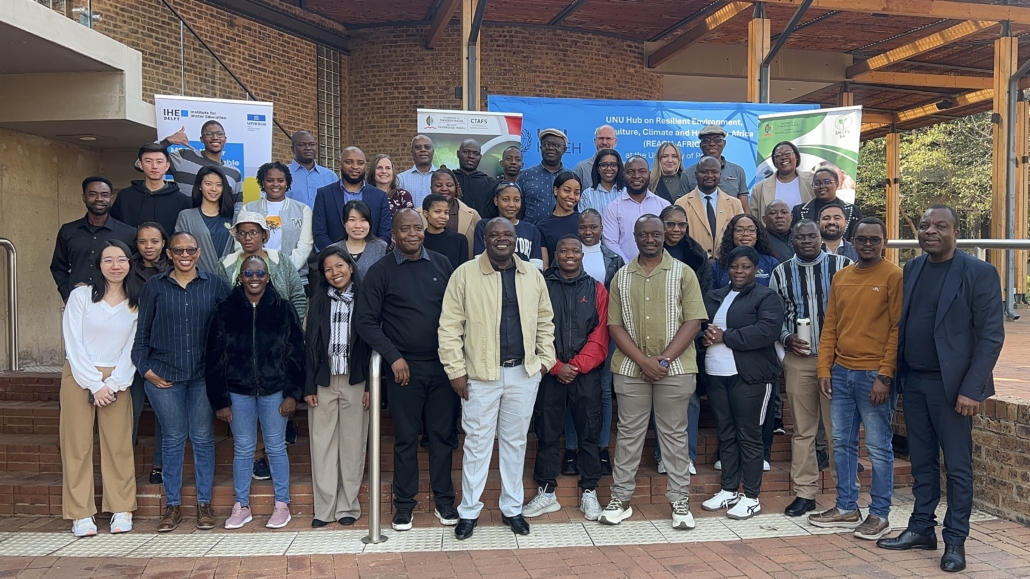
Researchers and doctoral students from across Africa and Asia are developing practical approaches to interconnected water, energy, and food challenges at a Water–Energy–Food (WEF) Nexus in-person Advanced School taking place at Future Africa, University of Pretoria, from 17 to 21 August 2026.
The WEF Nexus in-person Advanced School for the SADC region forms part of the broader effort to strengthen the capabilities of early-career researchers, postgraduate students, managers, and practitioners working across water, energy, food, environment, and health to understand and apply nexus approaches to sustainable natural resource management, human and environmental well-being, and socio-economic development. It brings together up to 40 researchers and doctoral students and 10 facilitators from across sub-Saharan Africa, Europe, and Southeast Asia.
Following an online WEF Nexus Masterclass held in May 2026, the in-person advanced school is focused on moving beyond theory to applying nexus thinking to real-world challenges. It also provides an opportunity to strengthen research skills, exchange knowledge, and build the networks needed to support more integrated and sustainable responses to complex development challenges.
A key part of the programme is practical, group-based learning. Participants are working in four country groups representing Ghana, South Africa, Tanzania, and Malaysia to explore WEF Nexus challenges in their respective contexts.
Through these exercises, they are examining the interdependencies between water, energy, food, environment, and health systems and how integrated approaches can support more sustainable and resilient solutions.
One of the key outputs of the week will be a policy brief developed by participants, translating the knowledge and discussions into a concise, policy-relevant resource to inform decision-making on WEF Nexus issues.
A collaborative approach to capacity development
The WEF Nexus Advanced School is a collaboration among the Water Research Commission, WaterNet, IHE Delft, the University of KwaZulu-Natal, the London School of Hygiene & Tropical Medicine’s Centre on Climate Change and Planetary Health, and the United Nations University (UNU) Hub on Resilient Environment, Agriculture, Climate and Health for Africa (REACH-AFRICA), a hub jointly established by Future Africa at the University of Pretoria and the UN University Institute for Water, Environment and Health (UNU-INWEH).
The programme is convened under the Global WEF Nexus Community of Practice and contributes to the FETE Doctoral Training partnership, which connects institutions with the aim of supporting doctoral research and capacity development.
Speaking at the opening session, Professor Tafadzwanashe Mabhaudhi, Executive Director of UNU Hub REACH-AFRICA, highlighted the importance of evidence-based approaches to addressing Africa’s interconnected challenges.
Reflecting on discussions around artificial intelligence and its implications for water, the environment, and health, Prof Mabhaudhi encouraged young researchers to engage critically with emerging technologies by asking, “What do the numbers tell us? What does the science say? And what are the smartest pathways for Africa?”
His remarks underscored the importance of combining scientific evidence, critical thinking, and context-specific knowledge when developing solutions for Africa.
As a strategic partner in the programme, UNU Hub REACH-AFRICA contributes to the programme’s focus on interdisciplinary research and capacity-strengthening, aligning with the Hub’s commitment to addressing Africa’s interconnected water, food, agricultural, environmental, climate, and health challenges.