You are here: Home1 / Challenge Domains2 / Climate, Water and Food Nexus3 / Future Africa-hosted Lancet Countdown Africa explores the cost of heat...
Future Africa-hosted Lancet Countdown Africa explores the cost of heat on birth outcomes
The Lancet Countdown Africa Regional Centre, hosted at Future Africa at the University of Pretoria, is drawing attention to an important but often overlooked consequence of rising temperatures: the health and economic impacts of heat exposure on pregnancy and birth outcomes in Africa.
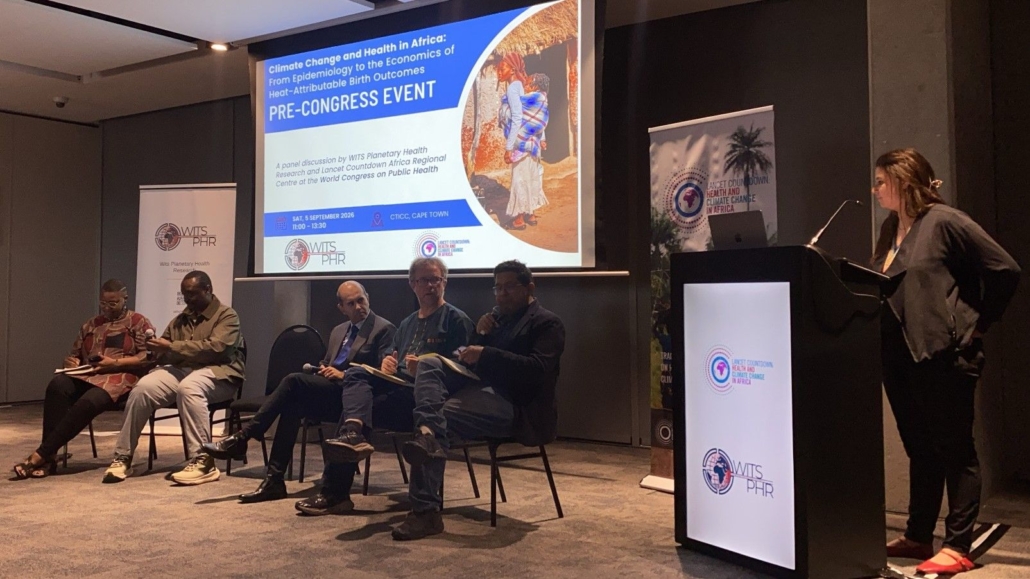
Together with Wits Planetary Health Research, the Centre convened a panel discussion ahead of the 18th World Congress on Public Health in Cape Town. The session brought together experts in epidemiology, health economics and public health to examine how evidence on heat-related health risks can inform policy, investment and climate adaptation.
Growing evidence suggests that heat exposure during pregnancy can contribute to adverse outcomes, including preterm birth. These impacts extend beyond immediate health concerns. Health systems may face increased costs associated with neonatal care and ongoing treatment, while families may experience additional healthcare and transport expenses and loss of income.
The discussion explored how researchers can better estimate the economic costs of heat-attributable preterm births in African countries by bringing together epidemiological evidence, national birth data and health economic analysis.
Professor Olufunke Alaba, Working Group 4 Lead of the Lancet Countdown Africa Regional Centre, highlighted how economic evidence can help decision-makers understand where investments could reduce risk, strengthen health systems and prevent future heat-related health impacts.
Professor Tafadzwanashe Mabhaudhi, Director of the Lancet Countdown Africa Regional Centre, emphasised the importance of systems thinking and collaboration across disciplines and sectors. Africa-specific approaches that reflect local health systems and data realities are important for strengthening evidence and translating it into policy and action.
The discussion forms part of the Centre’s broader work to strengthen evidence on the links between climate change and health in Africa and support its translation into action across the continent.
Read the full article published on the Lancet Countdown Africa Regional Centre website.