You are here: Home1 / Challenge Domains2 / Sustainability Transformations in Africa3 / Future Africa introduces new cohort of research fellows from 10 African...
Future Africa introduces new cohort of research fellows from 10 African countries
The Future Africa at the University of Pretoria (UP) is proud to introduce the second cohort of the Future Africa Research Leadership Fellowship (FAR-LeaF), a flagship UP initiative that seeks to develop the next generation of African research leaders. The new cohort brings together 22 exceptional early-career researchers who represent an emerging group of African scientific leaders committed to advancing knowledge for the benefit of society.
Funded by the Carnegie Corporation of New York, FAR-LeaF is a two-year fellowship designed to build the leadership, collaboration and transdisciplinary research skills needed to address Africa’s most persistent challenges. The programme equips postdoctoral scientists to work across disciplines and engage with society in ways that advance sustainable, evidence-informed solutions.
A defining feature of the FAR-LeaF model is its strong emphasis on mentorship and leadership development. Each fellow is paired with a senior academic from UP who provides tailored guidance on research design, academic writing, career development and opportunities for collaboration. These relationships begin during the programme’s orientation at Future Africa, where fellows meet their mentors in person and are introduced to the University’s wider research community. For many, it marks the start of a long-term partnership that will continue to shape their careers well beyond the two-year fellowship.
The new researchers will build on the achievements of the inaugural cohort, whose fellows produced impactful research outputs, forged significant collaborations and demonstrated clear evidence of the value of leadership-focused training. FAR-LeaF programme leader Professor Stephanie Burton expressed enthusiasm for the next phase of the programme.
“The success of the FAR-LeaF first cohort showed what becomes possible when we invest in early-career researchers who are ready to lead,” she said. “Their publications, partnerships and innovative work laid a strong foundation for what this programme can achieve. This new cohort brings the same depth of talent, and we look forward to supporting them as they develop research that will have a meaningful impact across the continent.”
The FAR-LeaF II contingent reflects the remarkable diversity of African institutions, with fellows drawn from universities and research organisations across West, East, Southern and Central Africa. Representing 10 countries, it brings a rich mix of contexts, expertise and research interests that span agriculture, climate change, health, governance, technology, freshwater ecosystems, food systems and science communication, reinforcing Future Africa’s mandate to serve as a collaborative platform that connects research excellence across the continent.
As the fellows begin their journey, they will participate in a structured programme that prepares them to influence policy, lead interdisciplinary teams and drive innovation. Through this experience, they will contribute to strengthening African research systems and shaping solutions that advance equitable, sustainable development.
The FAR-LeaF II Fellows
Country |
Name |
University |
Research focus |
| Benin | Alassan Assani Seidou | University of Parako | Improving decision-making in pastoral land politics for Women Livestock Farmers in Drylands of Benin (West Africa) |
| Botswana | Pearl Lefadola | University of Botswana | Upcycling Food Waste into Value-Added Products: A Sustainable Approach to Food Loss in Botswana’s Tomato Supply Chain |
| Ethiopia | Fenet Belay | Jimma University | Climate- Smart Coffee Futures:Climate Modeling, molecular breeding and gender responsive adaptation strategies for resilient coffee production in Ethiopia |
| Ghana | Enoch Kwame Tham-Agyekum | Kwame Nkrumah University of Science and Technology | Leveraging Community Radio for Climate Resilience and Social Learning in Drought-Prone Areas of Northern Ghana |
| Ghana | Jacob Agyekum | Water Research Institute, Council for Scientific and Industrial Research (CSIR-WRI) | Harnessing Community Resilience and Machine Learning for Adaptive Malaria Control amid Climate Change in the Upper West Region of Ghana |
| Ghana | Miriam Ameworwor | CSIR-Water Research Institute | Sustaining the livelihood of women fishers along the White Volta River in Northern Ghana |
| Ghana | Ato Fanyin-Martin | University of Mines and Technology | Generation of Sustainable Energy from Microwave Catalytic Pyrolysis of Agro-Products |
| Kenya | Juliana Cheboi | University of Nairobi | Enhancing resilience and sustainable food systems through nutritious climate-smart crops, behaviour change communication, and value addition technologies |
| Kenya | Sarah Otanga | Maseno University | Promoting Climate Change Literacy in Lower Primary Schools through Interactive Learning and Storytelling |
| Kenya | Ferdinand Lubobi Shamala | Masinde Muliro University of Science and Technology | Genome-Wide Association Study of Resistance Genes to Napier Head Smut in Kenyan Napier Grass |
| Kenya | Ruth Wainaina | Africa Center for Technology Studies | Enhancing Climate Resilience through Innovative Science Communication Among Smallholder Farmers in Murang’a County |
| Malawi | Jabulani Nyengere | Malawi University of Science and Technology | Developing and Upscaling Granulated Urine Fertilisers to Strengthen Food Security in Marginalised Communities |
| Nigeria | Ololade Abdulrahman | Kwara State University, Malete | Climate Change Vulnerability and Adaptive Capacity of Tomato Value Chain Actors: Empirical Evidence from Nigeria |
| Nigeria | Judith Falola-Olasunkanmi | Kwara State University Malete | Resilient Cropping Systems for African Smallholders: Integrating Weed Management, Climate Adaptation, and Agronomic Innovations |
| South Africa | Dina Coertzen | University of Pretoria | Informing malaria transmission dynamics to guide sustainable control interventions for disease elimination |
| South Africa | Tafadzwa Clementine Maramura | University of Free State | Integrating Smart Technologies in Community-Led Water Governance for Climate Adaptation in Cape Town |
| Tanzania | Yusuph Aron Kafula | Mwalimu Julius K. Nyerere University of Agriculture and Technology | Towards Resilient Freshwater Ecosystems: Assessing the interactive effects of light, temperature, and pesticide pollution on temporary ponds |
| Tanzania | Agnes Kapinga | Tengeru Institute of Community Development | Strengthening Urban Resilience through Community-Based Nature-Based Climate Solutions in Flood-Prone Areas of Dar es Salaam |
| Tanzania | Grite Mwaijengo | Nelson Mandela African Institution of Science and Technology | An Integrated Framework for Sustainable Schistosomiasis Control in a changing climate: A one health approach for Northeastern Tanzania |
| Tanzania | Gabriel Kanuti Ndimbo | Mkwawa University College of Education | Food insecurity and children’s malnutrition severity in agroecological zones of Tanzania: Insights from Njombe region |
| Tanzania | Jacquiline Ndosi | Mwalimu Julius K. Nyerere University of Agriculture and Technology | The role of agricultural innovation system toward empowering women farmers to climate change adaptation strategies |
| Zimbabwe | Piwai Tshuma | Midlands State University | Solar-Driven Photocatalytic Degradation of Organic Pollutants using Monolithic MOFs for Sustainable Water Remediation |
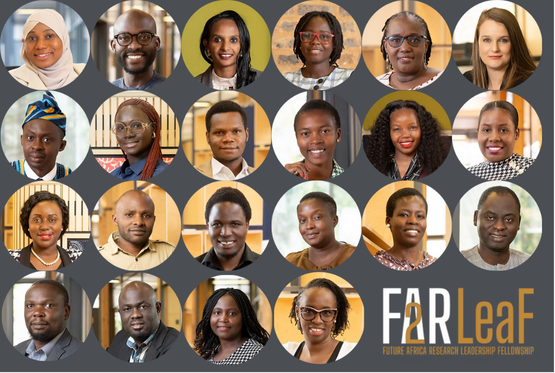
FAR-LeaF Cohort-2 Fellows