You are here: Home1 / Uncategorized2 / Dr Getrude Njokwe on curiosity, resilience and belonging in science
Dr Getrude Njokwe on curiosity, resilience and belonging in science
Future Africa at the University of Pretoria joins the global community in marking the International Day of Women and Girls in Science on 11 February. The day recognises women’s and girls’ contributions to science and the importance of gender equality in advancing scientific progress. To mark the day, we spoke to women researchers affiliated with the platform whose work supports African-led responses to complex challenges. We thank the researchers for sharing their experiences and insights.
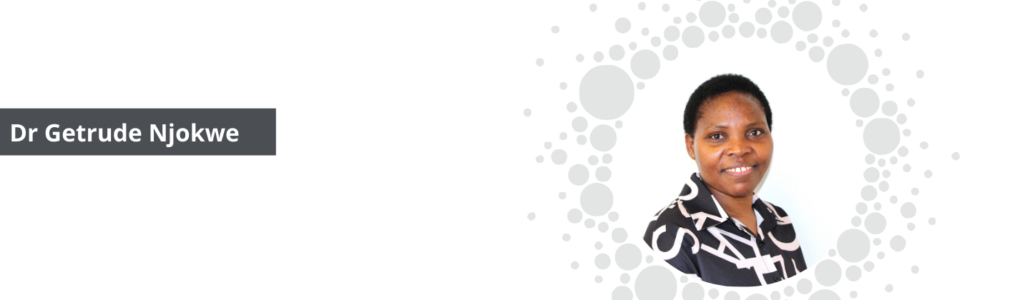
Dr Getrude Njokwe is a postdoctoral fellow at Future Africa at the University of Pretoria. Her research explores the intersections of health, environmental challenges, and sustainable development, with a focus on pandemic prevention, community engagement and education, green jobs and skills development, and youth employment in African contexts. She holds a PhD in Development Economics from the National Graduate Institute for Policy Studies in Japan.
What does the International Day of Women and Girls in Science mean to you personally?
For me, this day symbolises possibility and hope. When I look back at my childhood, filled with instability, interrupted schooling, and moments when education felt out of reach, I see how powerful it is when a girl holds onto her curiosity.
This day celebrates the courage it takes for girls to keep dreaming even when life gives them every reason to stop. It reminds me that potential can rise from the most difficult places, and that every girl deserves the chance to discover the brilliance within her.
What has made the biggest difference in enabling your journey in science and research leadership?
The turning points in my journey came through people who believed in me before I fully believed in myself. My path was marked by frequent school changes and periods when I stayed home because fees were unpaid, yet my love for mathematics never faded.
A teacher recognised my interest and paid my school fees so I could remain in class. Later, another family member helped me to continue my studies when I thought there were no more options.
Even in environments where I was overworked and had little time to study, I used mathematics to teach others and strengthen my own understanding. Those seasons taught me that leadership in science does not emerge from perfect circumstances. It grows from resilience, determination, and the belief that your future is worth fighting for.
Support opened doors, but it was perseverance that carried me through them.
What message would you share with girls who are curious about science but unsure if it is for them?
If you feel even the smallest spark of curiosity toward science, honour it. My own journey began in uncertain conditions, yet it was that simple love for mathematics that kept pulling me forward into possibilities far beyond anything I imagined.
You do not need a perfect starting point. You only need curiosity, courage, and the willingness to learn as you go. Science needs your questions, your creativity, and your unique way of seeing the world. Never underestimate the power of your voice. You belong in science.
Is there a guiding principle that has sustained you through your journey?
Perseverance is not about never falling. It is about rising each time life challenges you to stay down.
Take your first step today. Ask a question. Explore something new. Join a club. Read about a scientist who inspires you. Talk to a teacher or mentor you trust. Your journey can start with a single moment of courage and one day, your story may be the one lighting the path for others.