Africa Week 2025
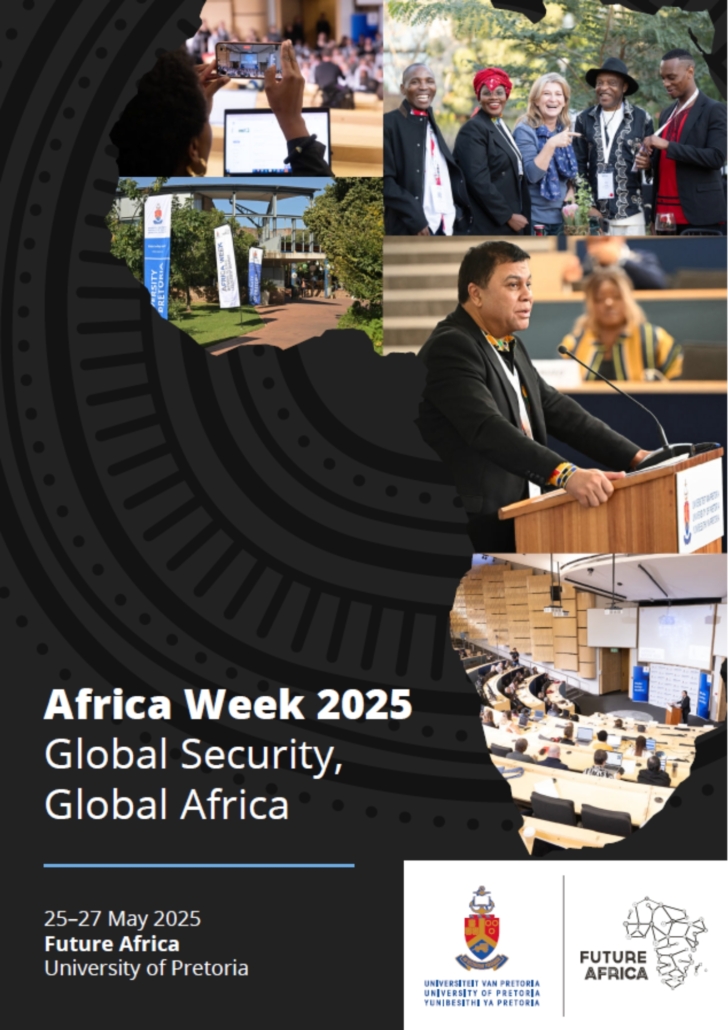
Future Africa at the University of Pretoria (UP) proudly hosted Africa Week 2025, the biennial science leadership summit of UP. This year’s edition was convened in partnership with the National Research Foundation (NRF) and the Department of Science, Technology and Innovation (DSTI). Held from 25 to 30 May 2025, the summit brought together more than 300 African and global leaders in science, policy, business, and civil society for high-level dialogue under the theme Global Security, Global Africa.
The main Africa Week 2025 summit hosted form 25 – 27 May explored global security through a distinctly African lens, focusing on six interconnected domains: climate, food, health, knowledge, economic, and socio-political security. Discussions explored the continent’s position in a rapidly changing world and addressed four guiding questions: Where are we at? What is at stake? What will it take? What about Africa? The summit broadened the definition of security beyond its traditional militarised framing, highlighting the systemic threats posed by climate change, pandemics, digital disruption, economic shocks, and instability in governance. Participants emphasised that Africa is not merely vulnerable to global crises; it is indispensable to global stability. With its mineral wealth and youthful population, amongst others, the continent holds assets that if strategically leveraged can reshape global systems.
Key themes and insights
Across plenaries, keynote lectures, roundtables, and side events, several themes emerged:
- Africa’s agency: The continent must shift from viewing itself as disproportionately affected to positioning itself as essential to global solutions.
- Collective leadership: Fragmented national responses slow progress; coalitions with the political will to act are crucial.
- Youth and skills: Africa’s demographic advantage must translate into meaningful participation in governance, research, and innovation.
- Indigenous knowledge: African knowledge systems can complement modern science and drive new models of innovation.
- Accountability: Reporting alone is insufficient—governance requires clear consequences for corruption and non-performance.
- Research with impact: Universities must move beyond knowledge production to knowledge application, co-creating solutions with industry and communities.
- Implementation at scale: Africa must build on proven models, avoiding repetitive cycles of dialogue without follow-through.
Africa Week 2025 brought together leaders from higher education, government, business, civil society, regional institutions, and the media. The summit served as a neutral platform for shaping agendas, informing policy, and strengthening the continent’s collective ability to navigate global uncertainty. Side events held from 28–30 May further deepened collaboration through workshops, partnership meetings, and programme launches.
Explore the Outcomes
Africa Week 2025 Report
The publication captures the insights, recommendations, and evidence-based contributions generated during the main Africa Week 2025 summit.
Click to download
Africa Week 2025 Highlights Video