You are here: Home1 / Challenge Domains2 / Sustainable Food Systems3 / Africa-led, locally grounded science powers new Lancet Countdown Africa...
Africa-led, locally grounded science powers new Lancet Countdown Africa Centre at Future Africa-UP
The launch of the Lancet Countdown Africa Regional Centre at Future Africa, the University of Pretoria’s (UP’s) Pan-African platform for collaborative research, will help generate high-quality, locally relevant data to support governments, institutions, and communities in responding to the health impacts of climate change.
The Lancet Countdown on Health and Climate Change is a globally recognised scientific collaboration that tracks the relationship between climate change and human health. Established in 2016, it brings together more than 100 institutions and hundreds of experts to produce annual, peer-reviewed reports, which are published in The Lancet, one of the world’s highest-impact academic journals.
Speaking at the launch, held at Future Africa earlier this month, Dr Marina Romanello, Executive Director of the Lancet Countdown, highlighted the importance of regionalisation in strengthening the initiative’s impact. Policymakers, she noted, rely more heavily on local and regional data than global datasets, making context-specific evidence essential.
The Africa Regional Centre will therefore play a key role in improving indicators and ensuring that data translates into meaningful action to protect public health.
She also underscored the ethical urgency of the work, noting that Africa sits at the epicentre of climate and health impacts due to the injustice of being disproportionately affected by a crisis it did not create. This reality reinforces the need for locally driven, evidence-based responses that reflect both scientific insight and lived experience.
Across the proceedings at the launch, a clear consensus emerged: scientific evidence alone is insufficient unless it is locally grounded, socially trusted, contributes to strengthening capacities, and is directly applicable to policy and practice.
Speakers hailed the Centre as more than a new research hub; the launch also signalled a decisive shift towards Africa-led climate and health science grounded in trust, relevance, and real-world impact.
Professor Tafadzwanashe Mabhaudhi, Director of the Centre, emphasised that the effectiveness of science is inseparable from its accessibility and credibility within the contexts it seeks to serve. Reflecting on earlier global climate reports, he pointed to a longstanding disconnect in how African realities have been represented within global knowledge systems.
“You’re enjoying the science… but you can’t relate to it as an African,” he said. “If I don’t trust you, if I can’t relate to you, what you say is not something I’m going to run with.”
He argued that the Centre’s mandate extends beyond scientific rigour to include contextual relevance and relational trust. For Prof Mabhaudhi, the goal is to cultivate a relationship between science and society that enables evidence to inform action across policy, research, and communities.
This perspective was echoed by UP Vice-Chancellor and Principal Professor Francis Petersen, who framed climate change as an interconnected challenge spanning multiple domains.
“Climate change is not only an environmental issue, but it is also a health issue, an economic issue, a development issue, a justice issue,” he said, stressing the urgency of placing health at the centre of climate responses to protect lives and livelihoods.
Prof Petersen further noted that Africa’s disproportionate vulnerability, despite contributing the least to global emissions, demands a shift in both knowledge production and global discourse. The Centre, he said, ensures that African scientists and perspectives are elevated within international conversations: “Africa for Africa in action.”
Beyond its continental significance, the launch has important implications for the Future Africa research platform at UP. Interim Director Professor Wanda Markotter emphasised that impactful research depends on transdisciplinary collaboration and active engagement beyond academia. Integrating diverse fields of knowledge is essential not only for generating insights but also for ensuring their application in real-world contexts.
A unifying thread across all contributions was the imperative for Africa to assert leadership in climate-health science through its own data, expertise, and institutional capacity.
The Centre will track climate-health indicators, strengthen early warning systems, generate and disseminate policy-relevant evidence, and translate findings into actionable insights while fostering collaboration, capacity building, and knowledge exchange across sectors and regions.
Equally significant is its role in developing the next generation of African scientists. Prof Mabhaudhi highlighted the importance of creating pathways for emerging researchers to participate meaningfully in global scientific discourse and to take ownership of knowledge production.
In doing so, the Centre and its work advance UP’s Thrive UP 2038 strategy by promoting African-led innovation, Planetary and One Health approaches, and research that strengthens policy, accountability, and sustainable development.
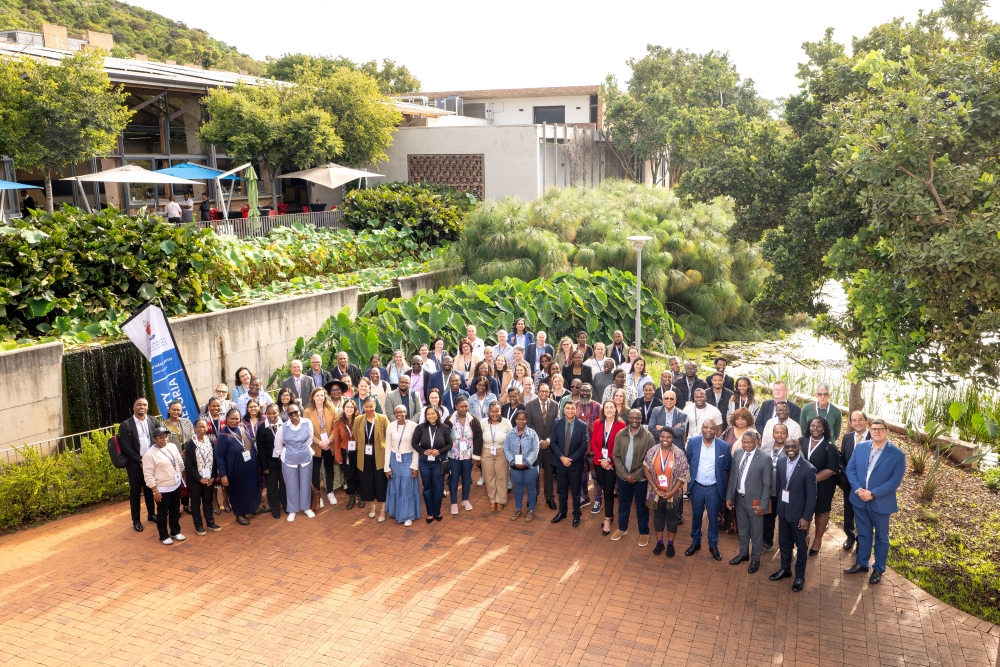
Delegates attending the Future Africa, University of Pretoria launch of Lancet Countdown Africa Centre (Photo:Eyescape)
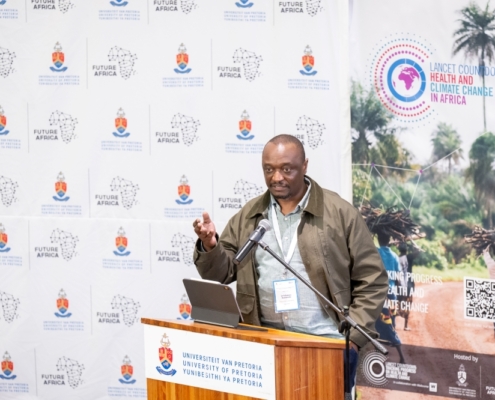
Prof Tafadzwa Mabhaudhi, Director of the Lancet Countdown Africa Centre (Photo:Eyescape)
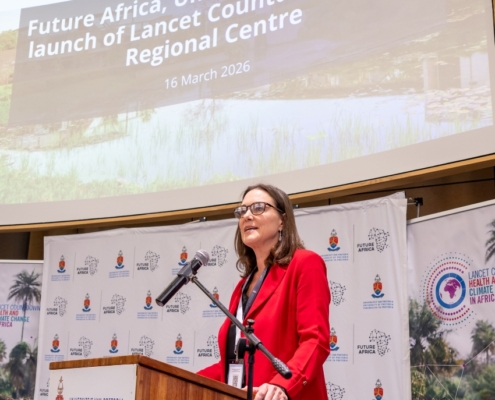
Prof Wanda Markotter, Interim Director of Future Africa at the University of Pretoria (Photo:Eyescape)